
We Used the Potty with Our Newborn Baby - Our Elimination Communication Journey
Free EC Guide
Grab your free guide to start EC today by filling out the form below.
I actually first came across the concept of Elimination Communication (EC) before I even had kids. My main driving force was for the environment. The thought of throwing away hundreds of disposable nappies into landfill over the span of raising children truly broke my heart.
I completely understand that to most people in Western society, the idea of holding a tiny infant over a potty seems pretty far-fetched and unconventional. Our culture is so conditioned to rely entirely on nappies that doing anything else sounds downright impossible! But the fascinating thing is that EC is actually the norm in many non-Western cultures around the world. In places like Asia, Africa, and parts of South America, mothers have traditionally read their babies' cues and held them over appropriate places to go since infancy.
As we brought more Montessori principles into our home, we realised EC fits perfectly into our goal of respectful, responsive parenting. Let’s chat about what EC actually is, how it’s different from traditional potty training, and what our reality looks like with Maddie.
What is Elimination Communication (EC)?
At its core, Elimination Communication is simply a practice where you use your baby's natural timing, physical signals, and cues to help them eliminate in an appropriate place (like a potty, toilet, or even outdoors) rather than in their diaper.
Instead of teaching a child to use a diaper as a portable toilet for three years, EC treats hygiene as a collaborative routine from infancy. It relies on four main tools:
Timing: Offering the potty at natural transition points (like right after waking up or upon taking them out of a baby carrier).
Signals: Watching for your baby's unique tells (fidgeting, grunting, a sudden pause in play, or a specific look).
Cue Sounds: Making a distinct sound, like "pssst" for pee or a gentle grunt for poop, while they eliminate so they associate the sound with the action.
Intuition: That sudden "mother's intuition" gut feeling that your baby needs to go.
How EC Differs From Potty Training
One of the biggest hurdles for people to wrap their heads around is that EC is different to potty training. Traditional potty training usually happens in toddlerhood (around two to three years old) and puts the responsibility on the child to recognise their needs and take independent action to ditch nappies completely.
EC, on the other hand, begins in infancy and is a collaborative, responsive partnership where you support your baby's natural rhythm. You’re not expecting a three-month-old to walk to the bathroom on their own; instead, you are simply maintaining their innate awareness of their bodily functions so they never lose it in the first place, using nappies merely as a backup safety net rather than a full-time toilet.
Common Misconceptions (Let's Debunk Them)
Let’s clear up some myths that usually make parents run for the hills:
Myth 1: "They don’t have sphincter control!"
This is a huge myth! While they can't hold it for hours like an adult, babies are born with the ability to relax and contract those muscles. In fact, many cultures around the world never use nappies at all.
Myth 2: "It’s too much work!"
You do NOT have to do EC full-time. Even catching one poo or pee a day is a win. It’s about the habit. The aim is not to strive for complete nappy dryness all day. Most parents who do EC, in fact, only do it part-time.
Myth 3: "It causes psychological harm!"
Early potty training only becomes stressful when it is forced or punitive. EC is the opposite. It is gentle, child-led, and based on communication, not training.
Our EC Journey with Maddie
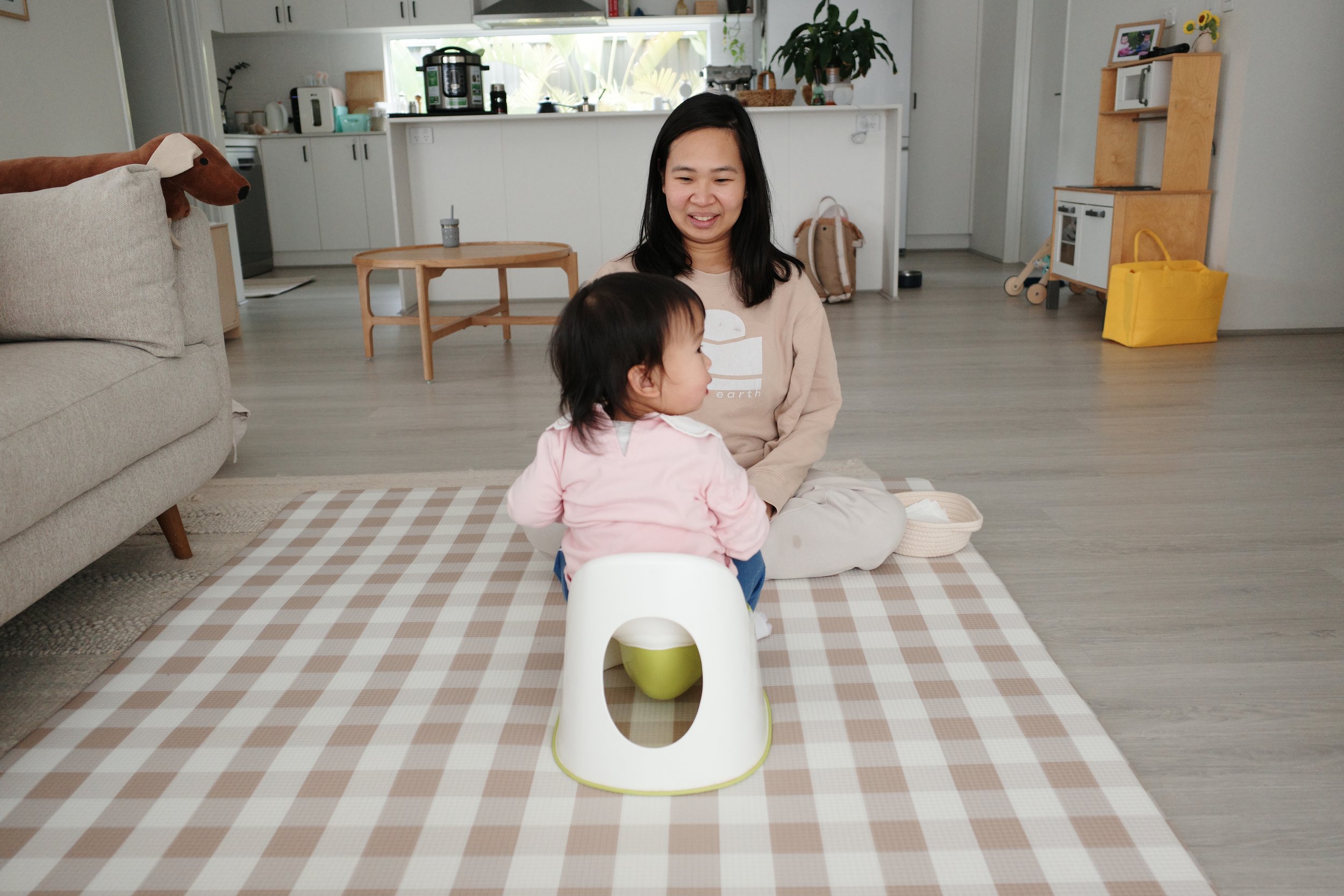
We started EC with Maddie when she was just one month old. It began very simply. We would just hold her over a small potty during nappy changes. By around four months, we noticed a pattern. She almost always needed to poo after her morning bottle. We decided to focus only on catching poos at first to keep things low-stress.
By seven months, once we introduced solids, she was pooping in the potty almost exclusively. We learnt her natural timing (usually after breakfast and dinner) and her specific cue: she always farts right before she needs to go!
As she grew, we adapted the communication. Since the ASL sign for "toilet" was a bit too complex for her hands, we taught her to pat her chest at 14 months. Now, at 18 months, she consistently tells us when she needs to poo, and sometimes pee by patting her chest.
Is it perfect? No! We have had misses, we have gone through classic "potty pauses" (where babies get so distracted by a new skill, like crawling or standing, that they temporarily stop caring about the potty), and that is completely normal.
5 Benefits of Doing EC
Here are five major benefits of practising EC with your baby:
Saves the Environment: You will save thousands of disposable nappies from sitting in landfill for centuries, drastically reducing your family's carbon footprint.
Reduce Nappy Rash: By reducing the amount of time your baby sits in a soiled nappy, your baby will experience far fewer instances of painful nappy rash.
Stronger Parent-Child Bond: Paying close attention to their subtle cues helps you understand your baby's needs on a deeper level before they can even speak.
Saves Money: You will be using fewer nappies day to day, and your child will also be out of nappies sooner than the average baby, which means less money spent on diapers over the years.
Easier Potty Independence: Because your child never loses the body awareness of when they need to go, transitioning to full potty independence later on becomes a natural next step rather than a confusing transition.